When Medications Haven't Been Enough
MeRT May Help
If you're dealing with treatment-resistant depression, anxiety, PTSD, or brain fog — and standard treatments haven't provided the relief you need — MeRT offers personalized, EEG-guided brain stimulation designed around your brain's actual patterns.
Important: What MeRT Is and Isn't
TMS (transcranial magnetic stimulation) is FDA-cleared for treatment-resistant depression and OCD. MeRT is a personalized protocol that uses EEG brain mapping to guide TMS treatment — built on this established foundation but customized to your brain's specific patterns. We'll always be transparent about what the evidence supports and what remains investigational.
You're Not Alone
When You've Tried Everything
and Still Feel Stuck
You've worked with therapists. You've tried multiple medications — maybe several rounds of adjustments. You show up for your life even when it costs you everything to do so.
And yet something still feels off. The fog. The flatness. The sense that your brain just isn't firing the way it should.
🌫️ Brain Fog & Cognitive Flatness
Difficulty concentrating, slow thinking, or feeling emotionally muted — even when life circumstances are stable.
🔋 Energy & Motivation Feel Inaccessible
Not laziness. A genuine inability to access the drive and energy that used to come naturally.
💊 Medications That Don't Quite Fit
Side effects that trade one problem for another, or treatments that help somewhat but never quite get you there.
🎯 Treatment That Feels Like Guesswork
Trying approach after approach without understanding why — or what's actually happening in your brain.
"Treatment-resistant symptoms often aren't truly resistant. They may need a different approach — one that addresses what's actually happening in your brain's networks."
A Different Understanding
Depression Isn't a Character Flaw.
It's a Network Problem.
For decades, depression was explained as a "chemical imbalance." That led to treatments that adjust brain chemistry broadly, hoping the right areas respond.
We now understand that depression, anxiety, PTSD, and related conditions may be better understood as disruptions in how brain networks communicate — specific circuits that have fallen out of their normal rhythm.
Think of it this way:
Your brain runs on electrical rhythms — patterns of activity that coordinate how different regions communicate. When those rhythms are disrupted, the downstream effects may show up as the symptoms you're experiencing.
Medications work on brain chemistry. MeRT works on brain rhythm. For some people who haven't responded adequately to medications, that distinction may matter.
The Treatment
What Is MeRT® — and How Is It
Different from Standard TMS?
MeRT (Magnetic e-Resonance Therapy) is a personalized form of transcranial magnetic stimulation (TMS) — a non-invasive technique that uses focused magnetic pulses to stimulate specific areas of the brain. What makes MeRT distinct is the EEG-guided personalization that precedes every treatment protocol.
Standard TMS
- Fixed stimulation frequency for all patients
- Targets a standard brain location by anatomy
- No baseline brain mapping before treatment
- Protocol doesn't adapt to your brain's response
- One-size-fits-all approach
MeRT® (EEG-Guided)
- Frequency matched to your brain's natural rhythm
- Location guided by your individual EEG data
- Baseline brain map before any stimulation begins
- Protocol updated every 10 sessions based on response
- Precision-targeted to your brain's actual patterns
The analogy that fits:
Standard TMS is like physical therapy with a generic exercise program. MeRT is like physical therapy where a specialist first measures exactly how your muscles are functioning — then designs a program specifically for what your body needs.
Cost & Insurance: Setting Clear Expectations
MeRT is generally a cash-pay service as the personalized protocol is not yet broadly covered by insurance.
Standard TMS is covered by many major insurers for treatment-resistant depression when medical criteria are met.
During your consultation, we'll discuss both options and help you understand which approach may be the better fit for your situation and budget.
How It Works
A Clear Path Forward —
Not Another Guessing Game
The Science, Simply Explained
Helping the Brain
Out of Stuck Patterns
The brain is remarkably adaptable. When you repeatedly stimulate a neural circuit in a specific way, the brain may respond by strengthening those connections — the same mechanism underlying learning and memory.
MeRT uses this principle by delivering stimulation at your brain's own frequency, potentially encouraging dysregulated networks to reorganize toward healthier patterns of activity.
🧠 Neuroplasticity
The brain can reorganize itself. Targeted stimulation may encourage new, healthier patterns of neural communication to form over time.
🎵 Frequency Matching
Stimulating at your brain's own rhythm — rather than a fixed frequency — may improve how efficiently the brain responds to treatment.
🔄 Network Coordination
Many symptoms may reflect poor coordination between brain regions. MeRT targets specific networks involved — not the whole brain indiscriminately.
📊 Objective Measurement
Unlike most psychiatric treatments, MeRT gives us something to measure. EEG data before, during, and after treatment lets us see what's changing.
Evidence & Safety
Grounded in Established Science.
Applied with Precision.
TMS has been studied for decades and is FDA-cleared for treatment-resistant depression and OCD. MeRT builds on this established foundation by adding EEG-guided personalization.
Many
patients with treatment-resistant depression experience meaningful improvement with TMS-based therapy
30+
years of research supporting transcranial magnetic stimulation as a safe, non-invasive treatment
Low
risk of serious side effects; most common is mild scalp discomfort in early sessions
Transparency matters: MeRT as a specific protocol is investigational and not yet broadly FDA-cleared — the underlying TMS technology is. We'll always be honest about what the evidence supports and what remains under study.
What Patients Often Notice
Meaningful Improvement
in Daily Functioning
We don't promise transformation. We aim for something more honest: meaningful improvement in the things that matter most to daily life. Here's what patients commonly report:
⚡ More Accessible Energy
Not a sudden surge — more like the gradual return of a baseline that used to feel normal.
🎯 Motivation Becoming Available
The ability to start things — and follow through — without it costing everything you have.
🌊 Wider Emotional Range
Less flatness. More capacity to feel — including positive emotions — without being overwhelmed.
💭 Clearer Thinking
Reduced brain fog. Sharper focus. Easier access to words, memory, and concentration.
😴 Better Sleep Quality
Many patients notice improvements in falling asleep, staying asleep, and feeling rested.
🤝 Other Treatments Working Better
When brain networks are more regulated, therapy and medications often become more effective.
What to Expect
Realistic Expectations.
Honest Timeline.
Session Length
~30 min
Most sessions are brief. You're awake and comfortable throughout. No anesthesia, no recovery time.
Frequency
5×/week
Monday through Friday, typically for 6–8 weeks. Consistency supports the brain's ability to change.
First Changes
Varies
Some patients notice early shifts in sleep, energy, or mood within 2–4 weeks. Others see more gradual improvement.
Sensation
Tapping
A gentle tapping sensation on the scalp. Mild discomfort in early sessions is common and typically resolves.
Important: Results vary significantly between individuals. Some patients experience substantial improvement; others partial or more gradual benefit. We'll set honest expectations during your consultation and track your progress objectively throughout treatment.
In Their Own Words
Patient Experiences
★★★★★
"A few months later, I woke up one day and felt like a switch had flipped. My anxiety and depression had improved significantly. I felt more like myself again — smiling more, being more active, engaging better in relationships."
Gizem T.
TMS patient · Gut Feelings Psychosomatic Medicine
★★★★★
"Unlike other practitioners I've worked with, Dr. Mike hasn't given up on me after trying several treatments. He told me we're working towards meaningful improvement. That level of commitment made all the difference."
Elizabeth L.
Patient · Gut Feelings Psychosomatic Medicine
★★★★★
"I'm halfway through treatment and am noticing significant changes in mood, perspective and social motivation. TMS is one of the few treatment options I feel is making a meaningful difference."
Oliver O.
TMS patient · Gut Feelings Psychosomatic Medicine
Why Gut Feelings
Not a TMS Mill.
A Thoughtful Practice.
Interventional Psychiatrist, Not a Technician
Dr. Hoaglin is a physician with backgrounds in emergency medicine, biomedical engineering, and psychiatry. He reviews your EEG, designs your protocol, and oversees your care personally.
Understanding Before Treatment
We don't start stimulating until we understand your brain. EEG mapping, clinical evaluation, and thorough history come first. Treatment follows understanding.
Integrated, Not Siloed
MeRT doesn't exist in isolation here. We consider how it fits with your medications, therapy, and overall health. We treat the whole system.
Measurement-Based Progress
We track your response with validated scales and repeat EEGs. You'll see objective data — not just subjective impressions — of how your brain is changing.
Your Physician
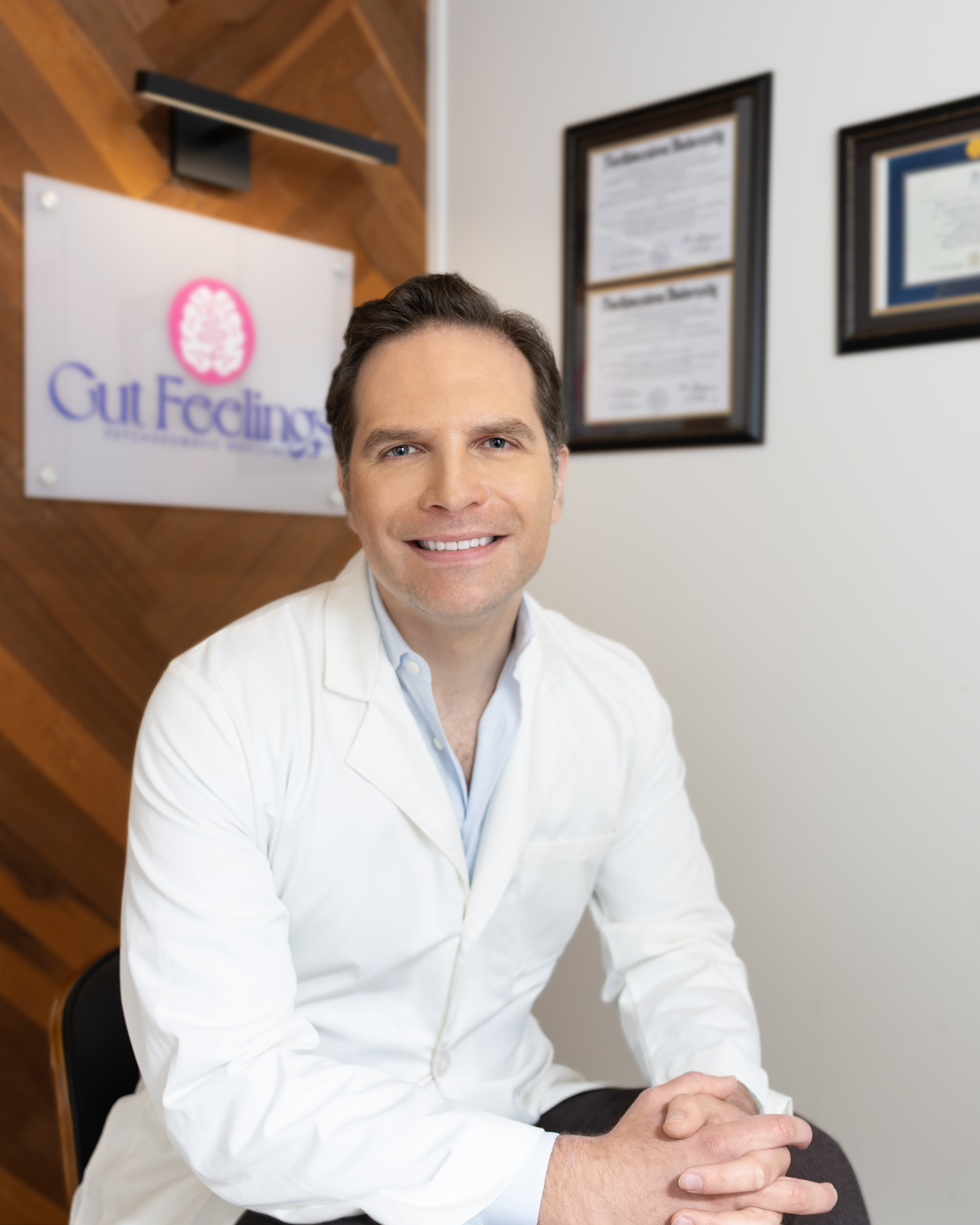
Dr. Mike Hoaglin, MD
Dr. Hoaglin is an interventional psychiatrist based in Oakland, CA. His background is unusual for a psychiatrist: dual engineering degrees from Northwestern University, medical training at the University of Pennsylvania, and residency at Duke University Hospital.
That engineering foundation shapes how he approaches brain-based treatments — with a precision mindset, a focus on measurable outcomes, and a genuine interest in understanding mechanisms, not just managing symptoms. He has extensive experience treating complex psychiatric cases and focuses on situations where standard approaches haven't been sufficient.
MD, Perelman School of Medicine, University of Pennsylvania
Residency, Duke University Hospital
BS Biomedical Engineering & Electrical Engineering, Northwestern University
Extensive experience treating complex psychiatric cases
Special interest: gut-brain axis, precision diagnostics, neuromodulation
Common Questions
What People Ask
Before They Book
Who is a good candidate for MeRT?
MeRT may be appropriate for adults experiencing treatment-resistant depression, anxiety, PTSD, cognitive symptoms, or related conditions who haven't found adequate relief from medications or other treatments. The best way to determine candidacy is through the initial EEG and clinical evaluation — we don't recommend treatment until we've reviewed your brain data and history.
Is MeRT covered by insurance?
MeRT as a specific protocol is currently a cash-pay service, as it is not yet broadly covered by insurance. The underlying TMS technology is FDA-cleared and covered by many major insurers for treatment-resistant depression when medical criteria are met. We can discuss whether standard TMS or MeRT may be the better fit for your situation during your consultation.
Is it safe? What are the side effects?
TMS has an excellent safety profile established over decades of research. The most common side effect is mild scalp discomfort or a light headache during the first week of treatment, which typically resolves. Seizure risk is low when treatment is delivered appropriately. No anesthesia, no systemic medication effects, no memory loss. You can drive yourself to and from sessions.
How is this different from ECT (electroconvulsive therapy)?
They are fundamentally different. ECT sends an electrical current directly through the brain to induce a controlled seizure, requires general anesthesia, and is performed in a hospital setting. TMS and MeRT use a moving magnetic field to gently influence brain activity — no electrical current passes through the brain, no seizure is induced, no anesthesia is required. You walk in, sit comfortably for a session, and walk out.
Do I have to stop my current medications?
In most cases, no. MeRT can be used alongside existing medications and therapy. In fact, many patients find that their medications become more effective after a course of brain stimulation. We'll review your current regimen during the consultation and flag any contraindications.
What if I've already tried standard TMS and it didn't work?
This is worth discussing. MeRT's EEG-guided personalization means the stimulation frequency and location are tailored to your brain's actual rhythms — which differs from standard TMS protocols. Some patients who didn't respond to standard TMS have responded to MeRT. We'd want to understand your prior treatment details before drawing any conclusions.
Find Out If MeRT Is Right for You
A free 15-minute consultation. We'll review your symptoms, treatment history, and next-step options. No pressure, no obligation.
Request Your Free Consult
We'll reach out within one business day to schedule your call with Dr. Hoaglin's team. Or book on your own in the next step.
If MeRT is not the right fit, we'll tell you.
Or call us directly: (510) 288-7847
Oakland: 400 30th St Suite 407
You Don't Have to Keep
Trying the Same Things.
If medications haven't been enough, and you're looking for something grounded in how your brain actually works — MeRT may be worth a conversation. We'll help you figure out if it's the right fit.
No obligation. No pressure. Just an honest conversation about whether this makes sense for you.
Gut Feelings Psychosomatic Medicine
400 30th St Suite 407, Oakland, CA 94609
(510) 288-7847 · [email protected]
Results may vary. TMS is FDA-cleared for treatment-resistant depression and OCD. MeRT as a specific protocol is investigational and not broadly FDA-cleared. All clinical claims are supported by published research; references available on request.
⚠️ Not an emergency service. If you are in crisis, call 988 or go to your nearest emergency room.
© 2026 Gut Feelings Psychosomatic Medicine. All Rights Reserved.